 info@dejunindustry.com
 +86 13721448067


Installation and Usage Precautions for Freestanding Jib Crane
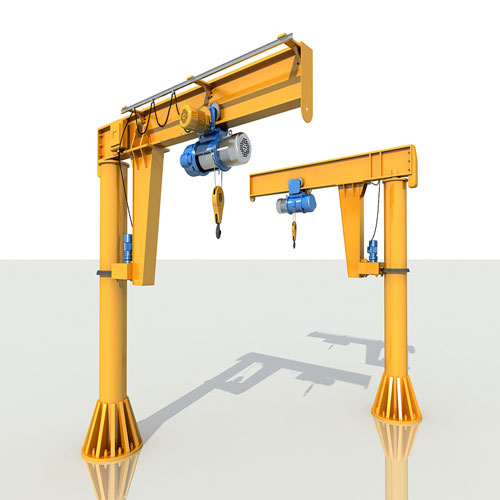
Freestanding jib crane (also called floor mounted jib crane, column mounted jib crane, pillar mounted jib crane), is a highly efficient workstation material handling equipment, which can be widely used in the production line, assembly line of the factory and some other working environment. The type of freestanding jib crane is BZ model. It is composed of columns, slewing arms, several chains, electric hoists, etc. The correctness of its installation and use directly affects safety and lifespan.
Ⅰ. Installation Stage Precautions
Installation of freestanding jib crane is the foundation for ensuring safety. It must be carried out strictly in accordance with the installation manual provided by the crane manufacturer and by professional personnel.
Basic Preparation and Inspection
Concrete foundation: This is the most crucial step. The foundation must be constructed by professional civil engineers according to the drawings.
Strength: The concrete grade is usually no less than C30.
Dimensions: The base depth, length, width dimensions, and the position of the embedded anchor bolts must be absolutely accurate.
Curing: The concrete must be adequately cured (usually for 28 days) until it reaches the designed strength before installation can commence.
Ground bearing capacity: For the type fixed to the hardened ground using anchor bolts, it is necessary to confirm that the ground (usually reinforced concrete ground) has sufficient bearing capacity, and its thickness is usually no less than 200 mm. Installation is strictly prohibited on ordinary cement ground or soft ground.
Ⅱ. Installation of Jib Crane Columns
Verticality: Measure using a high-precision level gauge or theodolite to ensure that the verticality deviation of the column in the front-back and left-right directions is ≤ 1/1000 (for example, for a 3-meter-high column, the vertical deviation should be less than 3mm). This is crucial for preventing rotation jamming and additional wear.
Fastening of bolts: All anchor bolts must be of high-strength type (with performance grade 8.8 or above), and should be tightened in accordance with the torque values specified by the manufacturer using a torque wrench in multiple stages, symmetrically and evenly. After tightening, secondary grouting is required.
Ⅲ. Cantilever Installation
Connection and fastening: The connecting bolts between the cantilever and the column are also high-strength bolts, and they must be tightened to the specified preload force.
Levelness: After installation, check the upward curvature and levelness of the cantilever. During no-load operation, there should be an appropriate pre-curve.
Ⅳ. Electrical Installation
Professional wiring: All electrical wiring must be carried out by certified electricians to ensure that the power voltage matches the equipment.
Safe grounding: The entire machine must have reliable grounding protection, with the grounding resistance being no more than 4Ω.
Limit setting: Immediately after installation, adjust the lifting upper limit position and the rotation limit position (if any) to ensure they operate sensitively and reliably.
Ⅴ. Test of Freestanding Jib crane
1. Preparation and inspection before the test
In order to ensure the safe and smooth operation of the test, the test equipment must be carefully inspected before the test and fully prepared for the test.
Turn off the power of the floor mounted jib crane and check the tightness of all connection parts; whether the assembly of each transmission mechanism rotates flexibly; whether the metal structure is deformed, etc.
When the power line is disconnected, comprehensively check whether the position of all equipment, lines, and components in the electrical system is correct and reliable.
Whether each lubrication point is filled with lubricating oil.
Prepare the weight for the test load. The weight can be a weight with a relatively large relative density. Its mass should be accurately measured and should be reliably tied.
2. No-load test
Turn on the power, start each mechanism to make it run, check whether the lifting and rotation directions are consistent with the button mark, first test it at a slow speed, and then run it at the rated speed. Observe that each mechanism should run smoothly without impact, vibration, abnormal sound, etc. The slewing stopper should be reliable.
Apply the rated load at the effective radius and measure the deflection. When loading, gradually load to the rated lifting capacity in 2 to 3 times.
3. Dynamic load test
The dynamic load test should be carried out when the crane is suspended with 1.1 times the rated lifting weight, and the operating speed should not exceed ±15% of the specified speed under the design voltage and rated frequency.
The dynamic load test should be carried out separately on each crane movement, and include the start and stop of each movement range.
After the dynamic load test, the relevant components should be able to perform their functions, and the mechanism and structural parts should not be damaged, and the joints should not be damaged or loose, which is considered qualified.
4. Static load test
When conducting a static load test, 1.25 times the rated load is applied at the effective radius. The load should be lifted off the ground and suspended for no less than 10 minutes, and then unloaded. Check that the crane has no cracks that affect safety, permanent paint peeling or obvious damage, which is confirmed to be qualified.
There is no abnormality in the test, and it is delivered for use after confirmation of qualification.
Ⅵ. Stage-specific precautions
Pre-use inspection (daily)
Structural components: Check for any cracks, deformations or rust on the columns, cantilevers, supports, etc. of the structure.
Connection parts: Check whether all bolts and pins are loose, missing or damaged.
Chain/Steel Wire Rope: Check for any twisting, broken wires, wear or rust.
Hook: Check for any deformation or cracks, and ensure that the safety tongue piece is intact.
Operating mechanism: No-load test run, check if the lifting and rotation functions are smooth and if there are any abnormal noises.
Brake: Test the reliability of the braking function.
2. Safety Guidelines During Operation
Strictly prohibit overloading: The load must not exceed the rated capacity of the column mounted jib crane (including the weight of the lifting gear).
Strictly prohibit slanting hoisting: Goods must be lifted vertically. Slanting hoisting will generate huge additional torque, which is highly likely to cause the column to bend or topple.
Smooth operation: Prohibit sudden lifting and sudden braking. The speed should be increased and decreased smoothly to prevent the load from swaying.
Revolving Area: During operation, no one is allowed to stand within the arm's revolving range. The operator must be located outside the rotating range of the load.
Load path: Pay close attention to the movement path of the load and avoid colliding with surrounding equipment or people.
Do not lift personnel: It is strictly prohibited to use a cantilever crane to lift or raise personnel.
3. Load and Tooling
Center of gravity: Ensure that the load's center of gravity is stable and hangs directly at the center of the hook.
Specialized tooling: Use properly designed lifting devices (such as slings and fixtures) to avoid using non-compliant ropes.
Ⅶ. Maintenance and upkeep
Regular inspection:
Weekly/Monthly Inspection: Re-tighten the critical connecting bolts (especially during the initial stage of use).
Annual inspection: A comprehensive inspection is conducted, including structural weld flaw detection and measurement of the main beam deflection, etc. This should be carried out by a professional institution.
2. Lubrication
Regularly apply the specified type of lubricating grease to the rotating bearings, lifting mechanism gears and other moving parts as per the manual requirements.
3. Anti-corrosion
Check for any damage to the surface paint layer and promptly apply new paint to prevent structural rusting.
The safety core of the freestanding jib crane lies in a qualified foundation, accurate installation and standard operation. Any negligence in any of these aspects could lead to serious safety accidents. It is essential to follow the "three don'ts" principle of "no overloading, no slanting pulling, and no standing personnel".
Henan Dejun Industry Co., Ltd has more than 30 years in jib crane filed, we have enough confidence to provide the top quality crane and suitable lifting solution for you. If you have any questions, contact us freely.
- The last one:What is Advantage of Eot Crane?
- The next one:No information!
